III Regional wares · Plate 019
Potter's tools
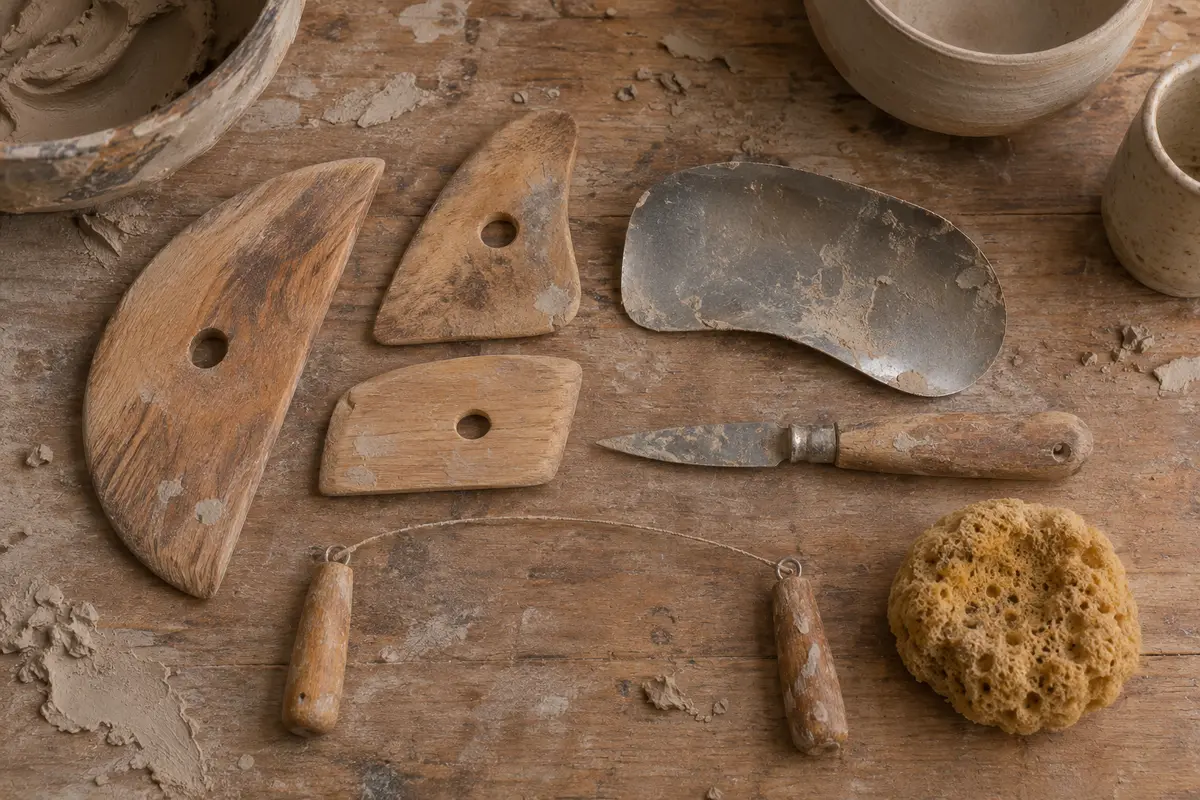
Potters work with simple hand tools, some improvised. In Nisa, the museum notes, a sewing needle scratches the design and thimbles or lamp caps mark circles.
Clay is soaked in a barreiro, a tank in the workshop, then sieved through wire into a second tank and left at least three days. It is flung in lumps called bonecos against a cement-covered brick wall, which absorbs moisture quickly, then kneaded on the atoquina table into cylindrical pélas, one for each piece. At the wheel the potter keeps a barranhão, a small clay pot of water; smooths the piece with an aplanata, a piece of felt, and a cana, a cane cut for the purpose; and separates it from the wheel head with a thread tied to a stick.
For handles, the potter works lamuge, a finer clay wiped from hands and tools and kept at the edge of the table, into a strip, cuts it with the fingers and glues it on with more lamuge. In winter a small fire sits near the potter so the clay does not streak with the cold. The museum notes that the traditional foot-driven wheel, worked with a pedal-like device at the bottom, is now used alone by only one potter, the others having turned to electric wheels. The red slip is made by dissolving red clay in water for hours and passing it through a silk sieve.
Source: museubordadoebarro.cm-nisa.pt
AI-generated illustration in the manner of the tradition, not a photograph of a specific object.