III Regional wares · Plate 011
Smoke-fired kiln
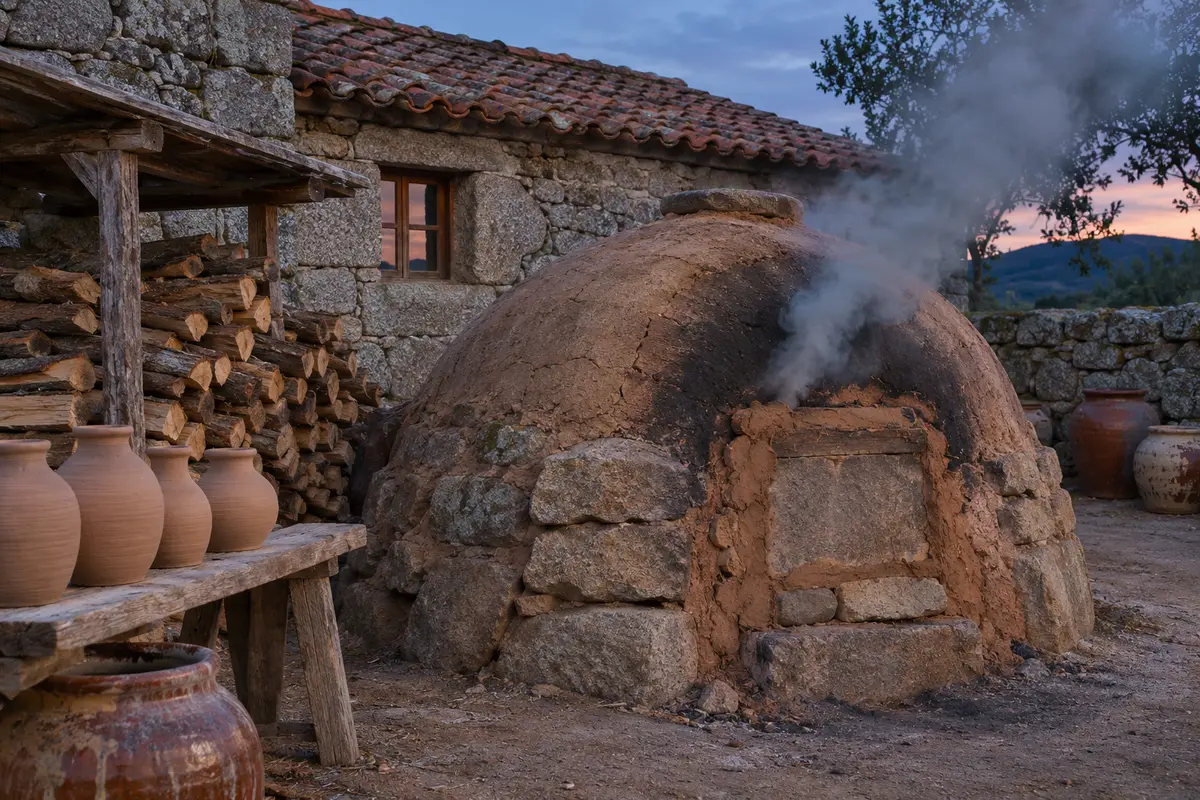
Black ware is fired in a reducing atmosphere, with little oxygen. In Molelos the oldest method, the soenga, uses a pit in the ground covered with sod and wood; wood and gas kilns are also used today.
The oldest way of firing ware in Molelos is the soenga: a circular pit dug in the ground that works as a kiln. What makes black ware black is not paint but the absence of air. In the Barcelos specification, firing black ware is almost the same as firing red, with one difference: at peak temperature the kiln is fed with wood and then closed completely. Once no oxygen enters the combustion chamber, carbon forms and is impregnated into the clay, which turns it black. That is why technical texts call it reduction firing, a firing with little oxygen.
At Bisalhães, as Diário de Notícias reported in 2016, pieces are fired in old kilns opened in the earth, burning broom, pine needles and carqueja, then smothered with dark earth, which gives the black. In Nisa the smoke is a stage to get rid of: traditional firing began with a low flame of thick logs for about an hour, producing dense smoke and blackened ware, followed by a bright flame of small brushwood once the fire turned orange at roughly 800 to 900 degrees, which burned the black off and left the pieces reddish.
Source: rtp.pt, cearte.pt, dn.pt, museubordadoebarro.cm-nisa.pt
Read about it: Black pottery, and the question of the colour →
AI-generated illustration in the manner of the tradition, not a photograph of a specific object.