I Tile types and patterns · Plate 038
Art Nouveau tile
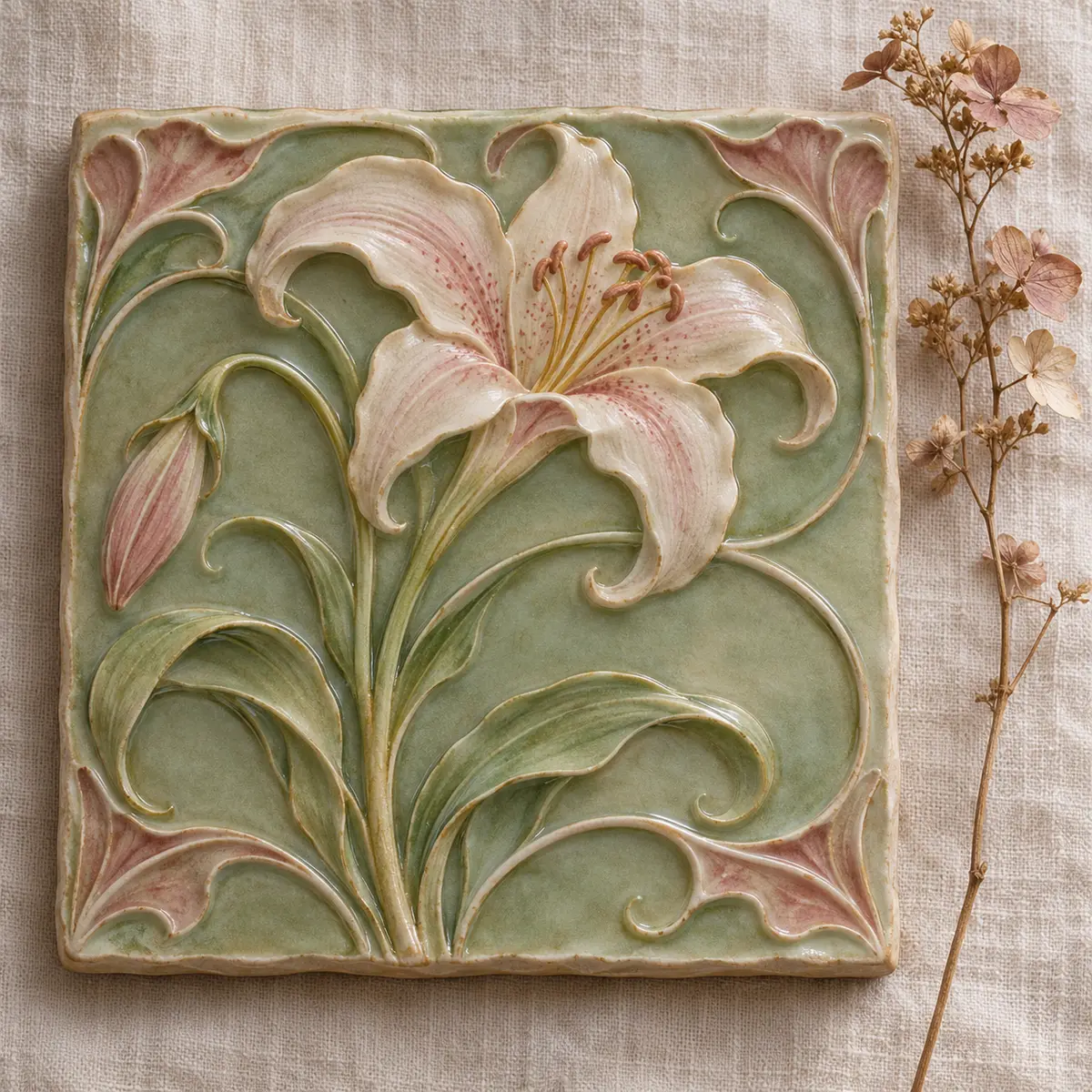
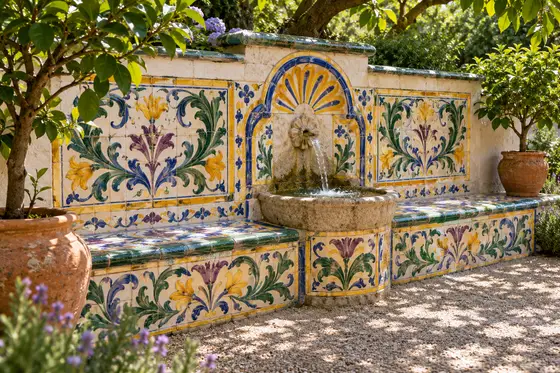
At the start of the 20th century Art Nouveau azulejos appeared, trading rigid repetition for plant motifs and curving lines.
Art Nouveau reached Portuguese tilework at the start of the 20th century. English Wikipedia names Rafael Bordalo Pinheiro, Júlio César da Silva and José António Jorge Pinto among those who made Art Nouveau azulejos, and notes that Bordalo founded his ceramics factory at Caldas da Rainha in 1885. The Museu Nacional do Azulejo says the influences came directly from France and describes Bordalo as the forerunner of this taste in Portuguese tile; they appear in three-dimensional ceramic pieces as well as in azulejos. Google Arts and Culture's record for his tile border adds that Art Nouveau was fully explored in Portugal after the Paris exhibition of 1900.
The best documented example is a pattern Bordalo created in 1902 for the Panificação Mecânica, a bakery in Campo de Ourique, Lisbon, where it was used on the counter. It is a relief pattern of a grasshopper on two ears of wheat among sinuous Art Nouveau leaves; a panel of it, dated 1905/1906, is held by the Museu Bordalo Pinheiro, and its borders are considered pioneering in Portugal. Only two such commercial decorations survive in Lisbon: the bakery and the Tabacaria Mónaco. A different Bordalo pattern with butterflies, dated 1905, is catalogued by the Museu Nacional do Azulejo.
Source: en.wikipedia.org, artsandculture.google.com, artsandculture.google.com
AI-generated illustration in the manner of the tradition, not a photograph of a specific object.